



Table of Contents
ISO 19650 is an international standard that defines how Building Information Modeling (BIM) information should be managed across the entire lifecycle of a built asset. Published by the International Organization for Standardization (ISO), it provides construction firms, architects, engineers, and facility managers with a consistent, globally recognized framework for producing, sharing, and storing project information.
The standard evolved from the British standards BS 1192 and PAS 1192, which were foundational to BIM adoption in the UK. ISO 19650 took those principles and expanded them into a framework applicable worldwide, now adopted across North America, Europe, the Middle East, Asia, and beyond.
At its core, ISO 19650 answers one essential question: how should information be managed on a construction project so that every stakeholder, from the client to the subcontractor, works from accurate, consistent, and trusted data?
Why ISO 19650 Matters for Construction Firms
Construction is one of the most information-intensive industries in the world. A single project can involve hundreds of stakeholders producing thousands of documents, drawings, and models. Without a structured framework, this creates version of conflicts, coordination failures, rework, and budget overruns.
ISO 19650 addresses this by establishing:
- A shared vocabulary so all parties understand terms the same way
- A defined process for how information flows from client to delivery team and back
- A structured environment (the Common Data Environment) where all project information is centrally managed
- Clear responsibilities for who produces, reviews, approves, and authorizes information
For construction firms working on BIM-enabled projects, aligning with ISO 19650 is no longer just a competitive advantage. Public sector clients, infrastructure agencies, and large commercial developers are increasingly mandating it as a contractual requirement.
The Structure of ISO 19650: Parts Explained
ISO 19650 is divided into five parts, each addressing a distinct aspect of information management.
Part 1: Concepts and Principles
This foundational part introduces the terminology, roles, and principles that underpin the entire standard. It defines key factors such as the Appointing Party (the client or employer), the Lead Appointed Party (the main contractor or BIM manager), and Appointed Parties (subcontractors and specialist consultants). It also establishes the concept of the Common Data Environment and describes the information model that sits at the heart of BIM delivery.
Part 2: Delivery Phase of Assets
The most widely referenced part of the standard. Part 2 covers the design and construction phase, detailing the step-by-step process for managing information from tender through to project handover. It explains how information requirements are set, how BIM Execution Plans are developed, and how the delivery team produces, checks, and delivers information.
Part 3: Operational Phase of Assets
Part 3 addresses what happens after the building is handed over. It covers how information is managed during the operational life of an asset, making it highly relevant for firms involved in BIM Facility Management or asset lifecycle services.
Part 4: Information Exchange
This part focuses on the technical aspects of information exchange between parties, covering formats, data structures, and naming conventions that ensure information retains its integrity as it moves across the supply chain.
Part 5: Security-Minded Approach to Information Management
Introduced to address growing cybersecurity concerns in BIM environments, Part 5 guides organizations on how to assess and manage the security risks associated with sharing sensitive building data digitally.
Key Concepts Every Construction Professional Must Understand
The Common Data Environment (CDE)
The CDE is a single, managed digital space where all project information is stored, shared, and controlled. It is not simply a shared folder or file server. Information within a CDE moves through defined workflow states:
- Work in Progress (WIP): Information being actively developed, visible only to the producing team
- Shared: Information ready for review and coordination by other delivery team members
- Published: Information formally authorized for use by the appointing party or wider project team
- Archived: Superseded or completed information retained for record purposes
Platforms like Autodesk Construction Cloud, Trimble Connect, and Bentley ProjectWise are commonly used as CDE solutions on ISO 19650-aligned projects.
Information Requirements
ISO 19650 establishes a hierarchy of information requirements that flow from the client down through the project supply chain:
Organizational Information Requirements (OIR) define what an organization needs to support its strategic objectives. Asset Information Requirements (AIR) specify what information is needed to operate and maintain the asset after handover. Project Information Requirements (PIR) identify what must be produced at key decision points during the project. Exchange Information Requirements (EIR) are issued by the appointing party to the delivery team, specifying exactly what information is needed, in what format, and by when.
The BIM Execution Plan (BEP)
The BIM Execution Plan is the delivery team’s response to the EIR. It is a living document that outlines how the team will produce and manage information throughout the project. A robust BEP covers software platforms, file naming conventions, model authoring responsibilities, coordination procedures, and quality control workflows. Construction firms are expected to develop a pre-contract BEP during tender, which is then refined into a post-contract BEP upon appointment.
Level of Information Need
ISO 19650 replaces the older concept of Level of Detail (LOD) with the more precise term “Level of Information Need.” This captures not just the geometric detail of a model element but also the alphanumeric data, documentation, and metadata associated with it, ensuring that the information produced at each stage of a project is appropriate for its intended purpose.
Appointing Party and Delivery Team Responsibilities
Under ISO 19650, the Appointing Party is responsible for defining what information they need and establishing the EIR. The Lead Appointed Party coordinates the delivery team and ensures that information produced by all parties meets the agreed requirements. Each Appointed Party produces information within their scope. This clear allocation of responsibility reduces ambiguity and makes accountability traceable throughout the project.
The ISO 19650 Information Delivery Process: Step by Step
ISO 19650 Part 2 outlines a structured eight-step process for delivering information during a project:
- Step 1: Assessment and Need – The appointing party identifies what information is needed and when establishing the PIR and EIR.
- Step 2: Invitation to Tender – The EIR is included in the tender package, communicating information requirements to potential delivery teams.
- Step 3: Tender Response – Delivery teams prepare a pre-contract of BEP as part of their tender submission, demonstrating their capability to meet the information requirements.
- Step 4: Appointment – The delivery team is formally appointed. The BEP is reviewed and agreed upon, forming part of the contract.
- Step 5: Mobilization The delivery team sets up the CDE, establishes collaborative workflows, agrees on software standards, and assigns responsibilities before production begins.
- Step 6: Collaborative Production of Information – Information is produced within the CDE following the agreed BEP. Each party works within their WIP space before sharing with the wider team.
- Step 7: Information Model Delivery – The completed information is quality-checked, authorized by the lead appointed party, and formally delivered to the appointing party at agreed project milestones.
- Step 8: Project Close – Information is archived or transferred to the asset information model, ready for use during operations and facility management.
How ISO 19650 Applies to Different BIM Disciplines
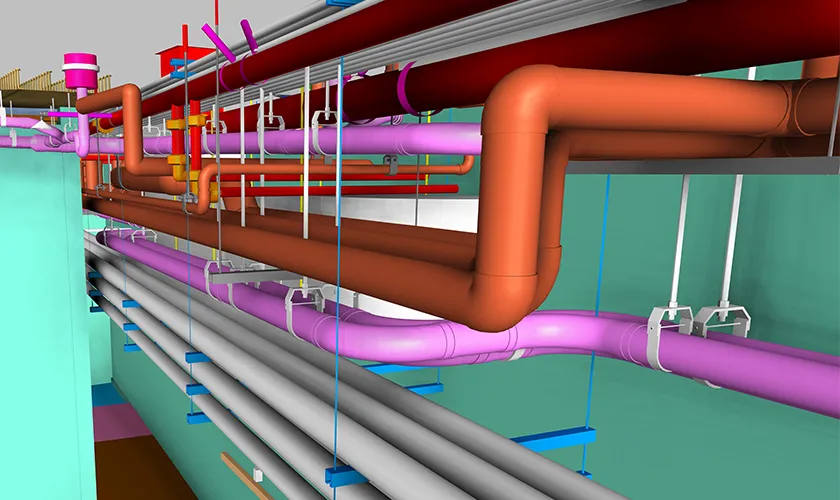
- MEP BIM Services – MEP teams producing Mechanical, Electrical, and Plumbing models must follow file naming conventions, submit models through the correct CDE workflow states, and ensure their models meet the Level of Information Need defined in the EIR. Clash detection reports and coordination outputs must also be managed and shared through the CDE in line with the BEP.
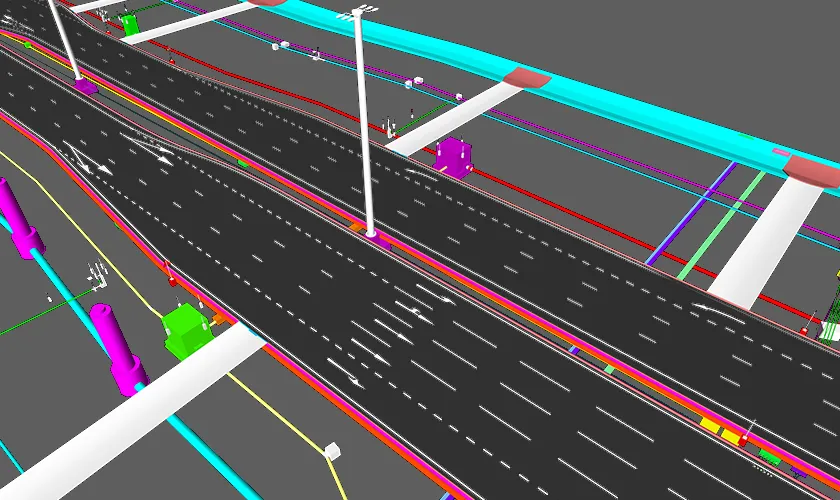
- Civil and Infrastructure BIM – On infrastructure projects, ISO 19650 governs how survey data, civil models, utility designs, and as-built documentation are produced and exchanged. For projects like roads, bridges, and water infrastructure, the standard ensures that civil engineers, structural designers, and contractors work from consistent, version-controlled information.
- Mechanical CAD Services – Firms providing mechanical 3D modeling, assembly drawings, and product design for construction projects must align their output formats and naming conventions with the project’s information requirements, ensuring deliverables integrate cleanly into the wider project information model.
- BIM Consulting – BIM consultants play a central role in ISO 19650 implementation. They help appoint parties to define their information requirements, audit delivery teams for compliance, develop BEP templates, and manage the CDE. Consultants also guide firms through the adoption process and train project teams on ISO 19650 workflows.
Benefits of ISO 19650 Compliance for Construction Firms
- Fewer Errors and Less Rework – Structured information management and coordinated CDE workflows catch clashes and inconsistencies early. This directly reduces the cost and frequency of design changes during construction.
- Improved Multi-Discipline Coordination – When MEP, structural, civil, and architectural teams all follow the same information standard, coordination becomes faster, clearer, and more reliable.
- Stronger Competitive Position – Clients issuing tenders for major commercial, healthcare, infrastructure, and government projects increasingly specify ISO 19650 compliance. Firms that can demonstrate alignment win more and larger contracts.
- Better Facility Management Outcomes – Information produced under ISO 19650 is structured, consistent, and complete at handover. This gives facility managers an accurate asset information model they can actually use for maintenance, operations, and future renovation.
- Clear Accountability and Audit Trails – The standard creates documented records of who produced, reviewed, and authorized every piece of project information. This is invaluable for dispute resolution, regulatory compliance, and project audits.
- Reduced Project Risk – With defined information requirements, consistent workflows, and a controlled CDE environment, the risk of information-related failures drops significantly across the project lifecycle.
ISO 19650 and BIM Software
ISO 19650 is software-agnostic. It does not prescribe which tools must be used. However, it does require that information be produced, managed, and exchanged in ways that meet defined requirements. In practice, this means construction firms typically use:
- Autodesk Revit for BIM authoring
- Navisworks for clash detection and model coordination
- Autodesk Construction Cloud or BIM 360 as the CDE platform
- Civil 3D or Bentley Open Roads for civil and infrastructure modeling
- COBie-compatible tools for structured data handover
Firms providing outsourced or offshore BIM services must also align their software environments and file exchange processes with the requirements specified in the project BEP.
Getting Started with ISO 19650: A Practical Roadmap
Adopting ISO 19650 does not require an overnight transformation. Most construction firms follow a phased approach:
- Phase 1: Awareness and Training – Train BIM managers, project coordinators, and senior engineers on the standard structure, terminology, and processes. BIM education resources and accredited training providers can support this.
- Phase 2: Gap Analysis – Audit current workflows, document management practices, and CDE setups against ISO 19650 requirements. Identify where the gaps are and prioritize which to address first.
- Phase 3: Template and Standard Development – Develop standardized BEP templates, EIR templates, file naming conventions, and model structuring guidelines aligned with the standard.
- Phase 4: Pilot Project – Apply ISO 19650 principles on a single project. Use it as a learning environment to refine processes before wider rollout.
- Phase 5: Organization-Wide Implementation – Roll out standardized workflows, train all project teams, and embed ISO 19650 compliance into the firm’s standard operating procedures.
Conclusion
ISO 19650 is the definitive international framework for managing information on BIM-enabled construction projects. For construction firms, understanding and implementing it is no longer optional. It is the foundation for delivering projects more efficiently, coordinating teams more effectively, and meeting the growing expectations of clients across every sector.
Whether a firm specializes in MEP BIM, civil infrastructure, mechanical CAD, or full-service BIM consulting, ISO 19650 provides the structure needed to deliver information that is accurate, consistent, and trusted from the first design stage through to facility handover. Firms that embrace it do not just comply with a standard. They build professional credibility and operational capability that defines excellence in modern construction.
FAQs
What is ISO 19650 in simple terms?
ISO 19650 is an international standard that tells construction firms how to manage project information when using BIM. It defines who is responsible for producing information, how that information should be stored and shared, and what quality checks it must pass before being used by others on the project.
Is ISO 19650 mandatory?
ISO 19650 is not universally mandated by law, but it is increasingly required by clients. In the UK, public sector projects and many large private developments specify ISO 19650 compliance. In the US, Middle East, and other regions, adoption is growing rapidly, particularly on government-funded infrastructure and healthcare projects.
What is the difference between ISO 19650 and BIM Level 2?
BIM Level 2 was a UK-specific framework based on PAS 1192 standards. ISO 19650 is its international successor, incorporating the same principles but within a globally applicable structure. Most countries transitioning from BIM Level 2 now reference ISO 19650 as the current standard.
What is a BIM Execution Plan under ISO 19650?
A BIM Execution Plan (BEP) is a document produced by the delivery team that outlines how information will be created, managed, and delivered on a specific project. It covers software, file naming, model responsibilities, quality control, and CDE workflows. It is produced in two stages: a pre-contract BEP during tender and a post-contract BEP once appointed.
What is a Common Data Environment (CDE)?
A CDE is a managed digital platform where all project information is stored, shared, and controlled. Information moves through defined workflow states (WIP, Shared, Published, Archived) to ensure that only authorized, quality-checked information is used by the project team.
What does Level of Information Need mean in ISO 19650?
The level of Information Need defines the appropriate amount and type of information that should be included in a model element or document at a given stage of a project. It encompasses geometric detail, alphanumeric data, and documentation, replacing the older concept of Level of Detail (LOD).
Who is the Appointing Party in ISO 19650?
The Appointing Party is the client or project owner who commissions the work and sets out the information requirements. They define what information is needed, in what format, and by when, through documents such as the EIR.
What is the Exchange Information Requirements (EIR) document?
The EIR is issued by the Appointing Party to the delivery team. It specifies exactly what information must be produced, at what Level of Information Need, in what format, and at which project milestones. The delivery team responds to the EIR through the BEP.
Can small construction firms implement ISO 19650?
Yes. ISO 19650 is scalable and applicable to projects of any size. Small firms can adopt its principles proportionally, focusing on the parts most relevant to their scope of work. Many start by aligning their file naming, CDE workflows, and BEP practices before tackling the full framework.
How does ISO 19650 relate to facility management?
Part 3 of ISO 19650 covers the operational phase of an asset. It ensures that the information model produced during design and construction is handed over in a form that facility managers can use for maintenance, operations, and future works. This is closely linked to COBie data standards and asset information model requirements.
What software is needed for ISO 19650 compliance?
ISO 19650 does not mandate specific software. Any platform that supports CDE workflows, version control, and structured information management can be used. Common choices include Autodesk Construction Cloud, BIM 360, Trimble Connect, and Aconex. BIM authoring tools like Revit, Civil 3D, and Navisworks are widely used alongside these platforms.
How long does it take to implement ISO 19650?
The timeline varies by firm size and existing BIM maturity. A small to mid-sized firm with some BIM experience can typically implement the core framework across six to twelve months through training, gap analysis, template development, and pilot project.

