



Table of Contents
A Building Information Model is only useful when project teams can trust the geometry and information it contains. BIM data validation is the structured process of checking whether model elements, properties, classifications, coordinates, relationships, and deliverables meet the requirements defined for a project. BIM data quality control is the wider system of reviews, responsibilities, software checks, and approval gates used to prevent unreliable information from progressing through design, coordination, construction, and handover.
Effective validation goes far beyond finding visible clashes. It confirms that a model is suitable for its intended use. A coordination model may need reliable geometry and clearances. A quantity model needs correct classification and measurable objects. A facility management model requires complete asset data, consistent identifiers, and usable links to operational documents. The required checks therefore change according to the project stage, discipline, contractual deliverable, and downstream use.
Organizations use BIM validation services to identify defects before they become RFIs, rework, procurement errors, rejected submissions, or unusable handover data. When validation is performed continuously rather than treated as a final review, it gives architects, engineers, contractors, owners, and facility teams a dependable information base for making decisions.
Direct answer: BIM data validation checks whether a model contains accurate, complete, consistently structured, and usable information. BIM quality control establishes the people, procedures, software, and approval stages needed to maintain that reliability throughout the project lifecycle.
What Is BIM Data Validation?
BIM data validation verifies that model information is correct, complete, consistently structured, and appropriate for a defined purpose. The process compares a model against project requirements such as the BIM Execution Plan, information exchange requirements, modeling standards, Level of Information Need, naming conventions, approved coordinates, classification systems, and required file formats.
A model can appear accurate in a 3D view and still fail validation. A fire door may be located correctly but carry the wrong rating. Mechanical equipment may be modeled at the correct size but lack a maintainable asset identifier. A structural member may have acceptable geometry but use the wrong material property. Validation exposes these less visible issues before the information is relied upon by another team.
The most effective approach combines automated rules with professional review. Automated tools can check thousands of objects for missing values, naming errors, duplicate elements, incorrect classifications, and spatial conflicts. Human reviewers still need to assess design intent, interpret exceptions, confirm whether values are technically credible, and determine whether a model is genuinely fit for use.
BIM Validation, Quality Control, Quality Assurance, and Auditing
These terms are related, but they describe different parts of information quality management. Clear distinctions help project teams assign responsibility and avoid relying on a single final inspection.
| Term | Primary Purpose | Typical Output |
|---|---|---|
| Quality Assurance | Prevents defects by defining standards, roles, templates, workflows, and training. | Quality plan, BEP procedures, approved content, responsibility matrix. |
| Quality Control | Checks current outputs against the agreed standards and acceptance criteria. | Checklists, clash reports, data reports, review status. |
| Validation | Confirms that a model or dataset is fit for a specific intended use. | Pass or fail results, compliance report, exception list. |
| Auditing | Provides a broader, often independent assessment of models and the process used to create them. | Audit findings, risk assessment, root causes, corrective actions. |
Why BIM Data Quality Control Matters
BIM data quality control protects the project from decisions based on incomplete or inaccurate information. Because BIM models support coordination, quantities, scheduling, fabrication, installation, commissioning, and operations, one poorly controlled dataset can affect several downstream workflows.
The cost of an information defect usually increases as the project advances. A missing parameter corrected during early design may take minutes. The same issue discovered after procurement can require schedule revisions, vendor clarification, data re-entry, and approval changes. A geometric conflict found before coordination may be simple to resolve. Once the affected systems are installed, the same conflict can require demolition and field rework.
Reliable quality control also improves accountability. Rule sets, issue logs, model reports, acceptance criteria, and approval records create an auditable trail showing what was checked, when it was checked, who reviewed it, and how nonconformities were closed. This is especially important on large multidisciplinary projects where information moves between several consultants, contractors, and software environments.
- Reduces coordination risk and preventable field rework
- Improves confidence in quantities, schedules, and procurement data
- Supports consistent submissions across architectural, structural, civil, and MEP teams
- Prepares asset information for commissioning and facility management
- Creates measurable acceptance criteria instead of subjective model reviews
- Protects the usability of open-format and contractual deliverables
What Should Be Checked in a BIM Model?
A complete validation strategy checks several dimensions of model quality. Running only clash detection is not enough because a clash-free model can still contain incomplete data, incorrect coordinates, unsuitable object types, or invalid exports.
1. Geometric Accuracy and Model Integrity
Geometric checks confirm that objects are modeled at the correct size, elevation, orientation, and location. They also identify duplicate elements, overlapping objects, disconnected components, modeling outside the agreed project boundary, invalid solids, and unnecessary detail that affects performance. Model integrity reviews may also examine warnings, file size, linked-model health, workset use, and family quality.
The required geometric tolerance should be defined in advance. Early concept models should not be judged by fabrication tolerances, while construction coordination models need enough precision to support routing, clearances, installation, and shop drawing production.
2. Clash, Clearance, and Spatial Validation
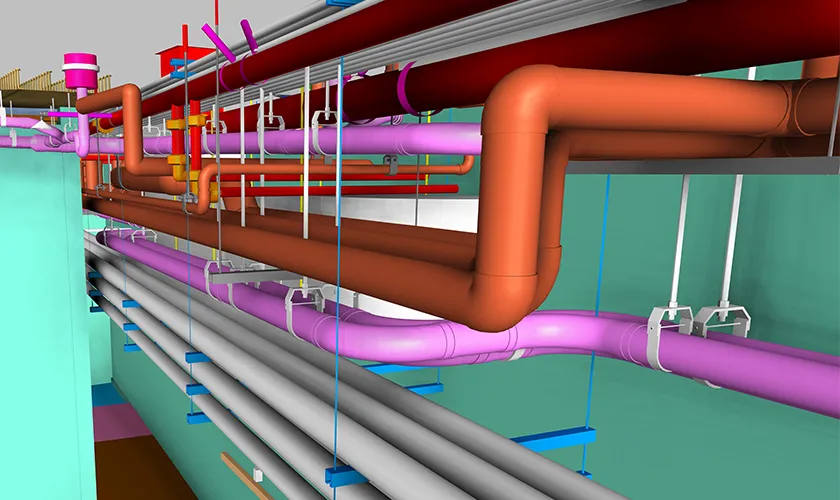
Clash detection identifies physical intersections between elements in a federated model. Hard clashes occur when objects occupy the same space. Soft clashes occur when an element enters a required access, safety, insulation, movement, or maintenance zone. Workflow checks identify conflicts related to construction sequencing, temporary access, lifting, or installation order.
Useful coordination requires carefully configured tests. Broad, unfiltered clash tests can produce thousands of low-value results. Effective BIM quality control services organize tests by discipline pair, system, zone, priority, and tolerance so that teams can focus on issues that affect constructability or operations.
3. Data Completeness and Accuracy
Data completeness checks confirm whether required properties are populated. Data accuracy checks determine whether the populated values are correct. Both are necessary. A parameter containing placeholder text may technically be complete but operationally useless.
Typical checks include asset identifiers, type names, system assignments, manufacturer fields, model numbers, fire ratings, performance values, classifications, warranty information, maintainability status, and document links. The required fields should be mapped to project stages so teams are not asked to supply information before it is available.
4. Standards and Naming Compliance
Standards checks verify that models follow the conventions defined in the BIM Execution Plan and related information standards. This may include file names, container naming, model breakdown, levels, grids, worksets, family names, type names, parameters, revision codes, status codes, classifications, and Common Data Environment metadata.
Consistent naming makes models easier to search, combine, audit, and hand over. It also enables reliable automation because rule-based checking depends on predictable data structures.
5. Coordinate and Federation Checks
All discipline models must use the agreed project coordinates, orientation, units, levels, and reference points. A coordinate error can displace an entire model and invalidate clash detection, quantity reviews, site setting-out, and downstream exports. Coordinate validation should be completed during mobilization and repeated at each formal exchange, especially when new consultants or subcontractors join the project.
6. IFC, COBie, and Exchange Validation
Native authoring models do not guarantee successful downstream exchange. IFC validation checks whether entities, property sets, classifications, geometry, and relationships survive export. COBie checks focus on structured spaces, types, components, systems, contacts, documents, and asset attributes required for operations.
Exchange files should be tested during the project, not only at final delivery. Regular trial exports allow teams to correct mapping, schema, and formatting problems while the responsible authors are still actively working on the models.
Architecture BIM Validation
Architecture BIM validation focuses on whether the architectural model supports design coordination, documentation, code review, quantities, downstream engineering, and construction use. Reviews may check room enclosure, area calculations, door and window data, wall and floor build-ups, fire and acoustic properties, accessibility clearances, ceiling coordination, facade zones, finish information, and consistency between model views and schedules.
The process should also verify the relationship between architecture and other disciplines. Openings must align with structural requirements. Ceiling zones must accommodate lighting, sprinklers, diffusers, and access panels. Equipment rooms must provide safe access and maintenance space. Architecture BIM validation therefore combines discipline-specific checks with federated coordination.
For complex projects, a formal architecture model audit can identify systemic problems that visual review may miss, including inconsistent room naming, duplicate type definitions, incorrect object categories, unreliable area boundaries, and families that do not carry the required information.
Design BIM Validation Across Project Stages
Design BIM validation should evolve as the model develops. Early validation concentrates on spatial logic, massing, primary systems, major interfaces, and compliance with the project brief. During detailed design, the focus expands to build-ups, system zones, equipment space, technical properties, schedules, and multidisciplinary coordination. Before construction, checks become more specific to constructability, installation, procurement, and contractual deliverables.
A stage-based validation matrix helps prevent two common problems. The first is over-checking information that has not yet been developed. The second is discovering at the end of design that essential data was never requested. Each milestone should define the required model uses, checks, tolerances, responsible reviewers, evidence, and acceptance thresholds.
Good design BIM validation does not replace professional design review. It strengthens it by giving reviewers structured evidence, repeatable rules, and a clear record of unresolved issues.
Data Center BIM Validation
Data centers demand a more rigorous validation strategy because they contain dense, interdependent systems and strict operational requirements. Power distribution, cooling, controls, fire protection, security, structural support, containment, and network infrastructure must fit within constrained spaces while maintaining redundancy, access, and future expansion capability.
Data center BIM validation should include more than standard clash detection. Reviews need to examine maintenance envelopes, equipment removal paths, overhead and underfloor zones, rack and cabinet clearances, busway routes, cable containment, cooling distribution, valve and damper access, fire-rated penetrations, floor loading, lifting routes, and segregation between redundant systems. Asset and system naming must also remain consistent because the model may support commissioning and operations.
Phased construction adds another layer of complexity. Validation should distinguish existing, temporary, planned, and future systems so teams can test each turnover condition. On live-site projects, point cloud comparisons and verified as-built updates can help confirm that the working model reflects actual field conditions before new work is coordinated.
A data center BIM validation plan should be aligned with the owner’s operational standards, commissioning strategy, security requirements, and handover platform. Generic model rules rarely capture the project-specific relationships that protect uptime and maintainability.
A Structured BIM Validation Workflow
Reliable BIM validation services use a repeatable workflow rather than isolated software checks. The following sequence can be adapted to project size, procurement route, and delivery stage.
1. Define the Intended Model Uses – Identify how each model and dataset will be used, such as design review, coordination, quantities, fabrication, construction sequencing, commissioning, or facility management. Validation criteria must reflect these uses.
2. Translate Requirements into Checkable Rules – Convert the BIM Execution Plan, exchange requirements, classification rules, naming conventions, Level of Information Need, and client standards into a validation matrix. Where practical, encode requirements in rule sets or IDS files.
3. Establish Responsibilities and Approval Gates – Assign author self-checks, discipline reviews, coordination reviews, independent audits, and client acceptance to named roles. Define what evidence is required at each Common Data Environment status transition.
4. Prepare and Federate the Models – Confirm file versions, coordinates, model boundaries, links, units, naming, and exchange settings before combining discipline models. Poor federation creates false results and wastes coordination time.
5. Run Automated Checks – Use configured rules to test geometry, clashes, clearances, properties, classifications, naming, duplicates, coordinates, IFC structure, and other measurable requirements.
6. Conduct Technical Review – Reviewers interpret automated results, remove false positives, assess design intent, identify patterns, and determine the technical and commercial priority of each issue.
7. Record and Assign Nonconformities – Log issues with a clear description, model location, responsible party, due date, status, supporting view, and acceptance criteria. BCF or an integrated issue platform can improve traceability.
8. Correct and Revalidate – The authoring team resolves issues and submits updated models. Checks are rerun to confirm closure and ensure that corrections have not introduced new problems.
9. Issue a Validation Report – The report summarizes the scope, files reviewed, rule sets, findings, exclusions, pass or fail status, unresolved risks, and recommended actions.
10. Approve, Publish, and Retain Evidence – Only accepted information should progress to the published or contractual state. Validation reports and issue records should be retained as part of the project information trail.
What Is BIM Data Auditing?
BIM data auditing is an independent or semi-independent review of model quality, process compliance, and information readiness. It is broader than a single automated check because it examines both the deliverable and the system used to create it. An audit may review models, the BIM Execution Plan, responsibility matrices, CDE workflows, naming standards, issue records, exchange files, and evidence of previous checks.
Organizations often request BIM data auditing before a milestone submission, when taking over models from another consultant, after repeated coordination problems, or before using model data for quantities and handover. The purpose is not only to list errors. A useful audit identifies root causes, patterns, risk levels, and practical corrective actions.
A model audit report should clearly distinguish verified findings from assumptions and exclusions. It should explain which files were checked, the model version, tools used, rules applied, tolerances, sampling method, and limitations. This allows stakeholders to understand exactly what the audit does and does not confirm.
BIM Data Validation Software and Automation
BIM data validation software allows teams to apply repeatable rules across large models and datasets. Common platforms support clash detection, property validation, classification checks, model health review, IFC checking, issue creation, and reporting. The right tool depends on the authoring environment, contractual format, project complexity, and type of information being checked.
Rule-based model checking platforms are useful for standardized geometry and data tests. Coordination platforms are effective for federating models and managing clashes. Authoring-tool plugins can detect problems earlier, before information is exchanged. IFC and IDS tools support open-format compliance, while COBie validators focus on structured asset data.
Software should not be selected only by feature count. Teams should consider whether it can read the required formats, configure project-specific rules, store reusable rule sets, produce understandable reports, export BCF issues, integrate with the CDE, and maintain an audit trail. BIM data validation software is most valuable when it supports an agreed process rather than operating as a stand-alone technical tool.
| Tool Category | Best Used For | Selection Questions |
|---|---|---|
| Authoring Model Checkers | Model health, warnings, family standards, parameters, naming. | Can issues be corrected before model exchange? |
| Federation and Coordination Platforms | Clashes, clearances, viewpoints, issue coordination, construction review. | Can tests be filtered and issues linked to the CDE? |
| Rule-Based Checking Software | Geometry, data, classification, accessibility, spaces, model rules. | Can project-specific rule sets be created and reused? |
| IFC and IDS Validators | Open-format structure and machine-readable information requirements. | Does the tool support the required IFC and IDS versions? |
| COBie and Asset-Data Tools | Handover data completeness, formatting, references, and import readiness. | Can the output be tested against the owner’s FM platform? |
| Issue Management Systems | Assignment, due dates, BCF exchange, status, dashboards, audit trail. | Does it preserve issue history and model-version context? |
How to Select BIM Validation Services
The best provider is not simply the firm that can run clash detection. BIM validation services should combine technical model expertise, information management knowledge, discipline awareness, and clear reporting. The provider must understand what the client intends to do with the model and build the review around that purpose.
Before appointing a provider, request a proposed scope showing the model uses, check categories, tolerances, software, review frequency, deliverables, issue workflow, and exclusions. A sample report is helpful because it shows whether findings will be presented as an actionable management tool or a raw export containing thousands of unprioritized results.
Experience should also match the sector. A hospital, rail project, manufacturing facility, and data center have different operational risks. A provider delivering data center BIM validation must understand system redundancy, maintainability, commissioning, and phased turnover, not only model geometry.
- Ability to convert project requirements into measurable validation rules
- Experience with the relevant disciplines, project type, and delivery stage
- Clear distinction between automated checks and professional technical review
- Transparent issue prioritization, ownership, and closure tracking
- Support for native models, IFC, IDS, COBie, and required client formats
- Reports that explain risk, root cause, and corrective action
- Secure handling of project models and controlled access to information
Typical Deliverables from BIM Quality Control Services
The deliverables should be agreed before checking begins. A well-defined package makes the review repeatable and gives the client evidence that models have been assessed against the requested criteria.
| Deliverable | Purpose |
|---|---|
| Validation Plan or Matrix | Defines model uses, checks, frequencies, responsibilities, tolerances, and acceptance thresholds. |
| Model Health Report | Summarizes file integrity, warnings, duplicates, content performance, coordinates, and standards compliance. |
| Clash and Clearance Report | Presents prioritized coordination issues with viewpoints, ownership, location, status, and due dates. |
| Data Completeness Report | Measures required property population by discipline, category, system, zone, or project stage. |
| IFC, IDS, or COBie Compliance Report | Documents exchange-format errors and compliance with machine-readable or handover requirements. |
| Audit Report | Explains findings, risk levels, recurring causes, process gaps, exclusions, and corrective recommendations. |
| Issue Register and Closure Evidence | Tracks nonconformities through assignment, correction, review, and final acceptance. |
| Management Dashboard | Shows trends such as issue aging, recurring errors, completion rate, model health, and stage readiness. |
Common BIM Data Quality Problems
- Inconsistent naming and classification – Different teams use variations for the same object, system, or property. This weakens search, automation, reporting, and handover. Controlled naming libraries and automated checks reduce inconsistency.
- Missing or placeholder information – Required fields are blank or contain temporary values that remain in the final model. Data drops and completeness dashboards should be scheduled throughout the project.
- Incorrect coordinates or levels – Models do not align in the federated environment. Confirming shared coordinates, units, levels, and reference points at every exchange prevents invalid coordination.
- Duplicate or unsuitable objects – Elements may be modeled more than once, assigned to the wrong category, or created with inefficient custom geometry. Integrity checks and family standards can detect these issues.
- Uncontrolled model warnings – Warnings accumulate until model performance and reliability decline. Teams should classify warnings, establish thresholds, and resolve high-risk items before submissions.
- Excessive clash results – Poorly configured tests generate noise and reduce confidence in coordination. Filters, tolerances, grouping, and discipline-specific tests improve actionability.
- IFC data loss – Properties, geometry, or relationships disappear during export. Trial exports, mapping reviews, and open-format validation should be part of regular delivery.
- Unverified as-built information – Models are updated from drawings or assumptions without field confirmation. Site verification, commissioning records, and point cloud comparison can improve handover reliability.
Best Practices for Strong BIM Data Quality Control
Quality should be designed into the workflow rather than inspected into the final deliverable. The following practices improve reliability without turning validation into unnecessary administration.
- Define model uses and information requirements before authoring begins
- Create stage-specific check matrices with realistic tolerances and acceptance thresholds
- Use standard templates, parameters, classifications, naming rules, and approved content
- Require author self-checks before discipline and federated reviews
- Automate repetitive tests but retain qualified human review
- Run trial IFC, IDS, COBie, and FM exports before final handover
- Track recurring errors and correct the underlying workflow, not only individual objects
- Measure quality trends such as issue aging, repeat nonconformities, completeness, and closure rate
- Keep validation evidence linked to the correct model version
- Review and update rule sets when the project scope or information requirements change
How Endeion Supports BIM Validation and Model Quality
Endeion provides BIM consulting, model auditing, coordination, and information management support for multidisciplinary projects. A validation engagement can be structured around the client’s model uses, BIM Execution Plan, exchange requirements, discipline standards, and delivery milestones.
The objective is to turn model review into an actionable quality process. This may include architecture BIM validation, MEP and structural checks, federated coordination, BIM data auditing, IFC and handover readiness reviews, issue tracking, and recommendations for improving authoring standards. For technically demanding environments, including industrial facilities and data centers, the validation scope can be tailored to maintainability, installation access, systems integration, and operational information requirements.
By combining automated checking with technical review, Endeion’s BIM quality control services help project teams identify information risks earlier, reduce preventable coordination problems, and deliver models that are more reliable for construction and operations.
Conclusion
BIM data validation and quality control determine whether digital models can be trusted for real project decisions. Reliable models require more than accurate-looking geometry. They need complete properties, consistent standards, valid coordinates, suitable classifications, dependable exchanges, disciplined review, and evidence that identified issues have been resolved.
A structured program of BIM validation services reduces risk across architecture, engineering, construction, commissioning, and facility management. It also provides a practical framework for controlling outsourced production, auditing inherited models, and preparing complex assets for handover.
Project teams that establish requirements early, automate measurable checks, retain qualified technical review, and validate throughout delivery are better positioned to reduce rework and create long-term value from BIM information.
FAQs
What is BIM data validation?
BIM data validation is the process of checking whether a Building Information Model contains the correct geometry, properties, classifications, naming, coordinates, and file structure required for its intended use. It compares the model against defined project requirements and records any nonconformities that must be corrected before the information is accepted.
What do BIM validation services include?
BIM validation services may include model health checks, clash and clearance detection, standards compliance, property completeness, coordinate verification, IFC and COBie validation, design-stage reviews, issue reporting, and revalidation after corrections. The exact scope should be based on the model use, discipline, project stage, and contractual deliverables.
How is BIM data auditing different from model checking?
Model checking usually applies specific rules to a particular file or federated model. BIM data auditing examines a broader set of evidence, which can include the models, BIM Execution Plan, CDE process, responsibilities, exchange settings, issue records, and previous validation reports. Auditing is useful for identifying systemic risks and root causes.
Which BIM data validation software is commonly used?
Common tool categories include rule-based checking platforms, coordination and clash detection software, authoring-tool model checkers, IFC and IDS validators, COBie validation tools, and issue management systems. Selection should depend on required formats, rule configurability, reporting, BCF support, CDE integration, and the project’s acceptance criteria.
Why does architecture BIM validation matter?
Architecture BIM validation checks more than visual design quality. It helps confirm room and area information, door and window data, fire and acoustic properties, accessibility clearances, wall and floor assemblies, ceiling coordination, model standards, and alignment with structural and MEP requirements.
What is different about data center BIM validation?
Data center BIM validation must address dense service coordination, redundant system separation, maintenance clearances, equipment replacement paths, cable and busway routing, cooling distribution, fire-rated penetrations, floor loading, phased construction, commissioning data, and operational naming standards. These checks support constructability and long-term uptime.
How often should BIM quality checks be performed?
Checks should occur throughout model production. Authors should self-check before each submission, discipline coordinators should review shared models regularly, and federated checks should follow the coordination schedule. Formal validation should also occur at every stage gate, contractual exchange, and final handover.
Can BIM quality control services eliminate all model errors?
No review can guarantee that every defect will be found. Quality control reduces risk by applying agreed rules, technical judgment, repeatable workflows, and documented issue closure. Reports should state the scope, files, tolerances, exclusions, and limitations so stakeholders understand the level of assurance provided.
What should a BIM validation report contain?
A useful report identifies the files and versions reviewed, project requirements, software and rule sets used, tolerances, findings, issue priorities, unresolved risks, exclusions, and acceptance status. It should also provide enough information for responsible teams to locate, correct, and close each issue.
When should an independent BIM audit be requested?
An independent audit is valuable before major submissions, when models are inherited from another consultant, when quality problems repeat, before quantities or fabrication rely on the model, and before asset information is handed over. It can provide an objective view of model readiness and process compliance.

