


BIM Content Creation Services for Consistent Project Delivery
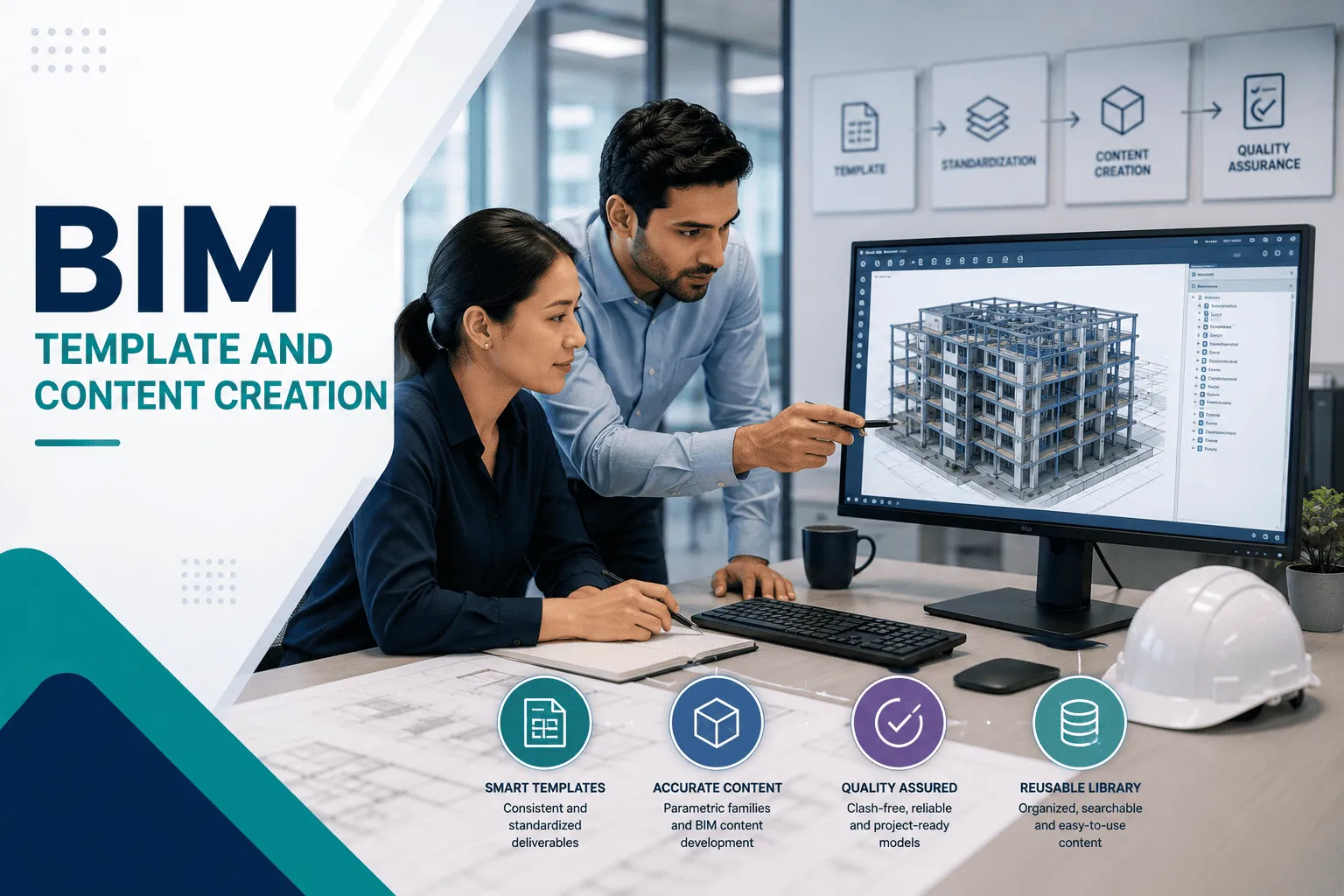
Reliable BIM delivery depends on more than capable software and experienced modelers. Teams also need standardized templates, dependable families, clear parameters, and organized content that behaves consistently across projects. Endeion provides BIM content creation services for architecture, engineering, construction, and product manufacturing teams that want to improve project setup, documentation consistency, model usability, and content control.
Our specialists develop and update Revit templates, parametric families, BIM objects, and structured content libraries around the client’s existing standards and intended use. The scope may range from one project-specific family to a firm-wide template and content system covering multiple disciplines, office locations, project types, or manufacturer product lines.
Each assignment begins with a review of the information available, the software version, required outputs, naming conventions, parameter standards, and approval process. This helps ensure that the delivered content fits the client’s workflow instead of forcing teams to work around generic defaults.
Why Standardized BIM Templates and Content Matter
When every project begins with different settings, families, parameter names, graphics, and documentation methods, project teams spend valuable time recreating basic content and correcting inconsistencies. Uncontrolled libraries can also introduce duplicate objects, incomplete data, oversized families, unreliable schedules, and documentation that varies from one team member to another.
A structured BIM template and content creation program gives teams an approved starting point. It can standardize how models are organized, how drawings are presented, how information is scheduled, and how common building elements behave. The result is not automatic project success, but a more dependable environment for modeling, review, coordination, and documentation.
- Reduce repetitive project setup and content rebuilding.
- Improve consistency between models, sheets, schedules, and project teams.
- Support clearer naming, classification, parameter, and file-management practices.
- Provide reusable content that reflects the intended design or product requirements.
- Make approved BIM standards easier to apply across new projects and team members.
- Improve control over legacy content, revisions, and library updates.
BIM Template and Content Creation Services We Offer
Endeion’s BIM template and content creation services are scoped according to the client’s current workflow, content maturity, project standards, and expected use. Services can be commissioned separately or combined into a wider standardization and implementation program.
| Service | Typical Scope |
|---|---|
| Custom BIM Templates | Project settings, views, sheets, schedules, graphics, parameters, and organization aligned with agreed standards. |
| Revit Family Creation | Parametric or fixed-content families developed for design, documentation, coordination, or manufacturer workflows. |
| Template Customization | Updates to existing templates when standards, software versions, deliverables, branding, or project requirements change. |
| BIM Content Libraries | Structured collections of approved families and objects with consistent naming, classification, and folder organization. |
| Manufacturer BIM Objects | Product-based content created using verified dimensions, specifications, options, and manufacturer data. |
| Content Review & Optimization | Review of legacy families and templates for usability, consistency, duplication, file performance, and compliance with current requirements. |
Custom BIM Template Creation
Our BIM template creation service develops a structured Revit starting environment based on the client’s approved standards. Depending on scope, a template may include units, object styles, line weights, line patterns, fill patterns, materials, annotations, view templates, filters, browser organization, sheets, title blocks, schedules, legends, parameters, phases, worksets, and other settings required for repeatable project setup.
Template content is selected for a defined purpose. An architectural design template may require different views, families, graphics, and schedules than an MEP coordination template, a contractor documentation template, or a manufacturer-focused content environment. Endeion reviews these intended uses before development, so the template remains practical rather than overloaded with unnecessary settings and objects.
BIM Template Customization
Existing templates often become outdated as a company changes software versions, branding, drawing standards, BIM execution practices, project types, or information requirements. BIM template customization allows those files to be revised without rebuilding the entire system from the beginning.
Endeion can review existing templates and update agreed components such as title blocks, sheet structures, view naming, schedules, parameters, browser organization, annotation standards, filters, graphics, or included families. Proposed changes are documented and tested before delivery, so the client can review how the revised template affects live project workflows.
Revit Family and BIM Object Creation
Families and BIM objects represent the components used throughout a model, including architectural elements, structural components, equipment, fixtures, accessories, and MEP products. Endeion develops custom content from approved drawings, product data, dimensions, schedules, photographs, or reference models supplied by the client.
Content can be developed with fixed or parametric behavior depending on how it will be used. Where required, the scope may include type parameters, instance parameters, formulas, nested families, shared components, type catalogs, materials, connectors, symbolic representation, visibility controls, clearance zones, and information fields. These features are defined during scoping because not every object needs the same level of geometry, data, or flexibility.
Architectural, Structural, and MEP BIM Content
BIM content creation services can support multiple project disciplines. Architectural content may include doors, windows, furniture, casework, fixtures, specialty equipment, signage, or interior components. Structural content may include approved connection components, framing accessories, embeds, precast elements, or other project-specific objects. MEP content may include mechanical equipment, plumbing fixtures, valves, accessories, electrical devices, panels, and other systems components.
For MEP content, connector configuration and system behavior are established from the available technical information and intended use. Engineering performance, product selection, and design approval remain the responsibility of the client and the appropriate licensed professionals.
Manufacturer BIM Content Creation
Product manufacturers can use BIM objects to make approved product information easier for architects, engineers, contractors, and specifiers to use in project models. Endeion can develop manufacturer content from verified dimensional drawings, options, product schedules, technical data, and brand requirements.
The goal is to create content that communicates the product without adding unnecessary geometry or data. Depending on the intended audience, objects may include configurable types, product codes, materials, dimensions, performance fields, connection points, clearance information, classification data, or links to supporting documentation. The manufacturer reviews the final information for product accuracy before publication or distribution.
BIM Content Library Development and Management
A useful content library is more than a collection of files. It needs a logical structure, consistent naming, clear ownership, and a process for review and updates. Endeion can organize new or existing content into a library framework based on discipline, category, project type, manufacturer, approval status, software version, or other agreed classifications.
Library work can include duplicate review, file naming, parameter alignment, family categorization, folder organization, type cleanup, version identification, and content indexing. Where requested, Endeion can also prepare concise user guidance, so team members understand which files are approved and how they should be applied.
Legacy BIM Content Review and Optimization
Older families may still contain valuable information, but they can also carry obsolete parameters, broken constraints, inconsistent naming, excessive geometry, duplicated types, or graphics that no longer match current documentation standards. A structured review helps determine which files should be retained, corrected, simplified, rebuilt, archived, or removed.
Optimization is based on intended use. A family used early design may need lightweight geometry and basic data, while a family used for detailed coordination or product selection may require additional information. Endeion avoids adding complexity that does not support a defined project or business needs.
What Can Be Included in a BIM Template Services?
Template contents vary by company and project type. The following groups show typical items that may be included after review and approval.
Project Setup and Model Organization
- Project units, levels, grids, phases, coordinates, and worksharing settings where applicable.
- Browser organization, naming conventions, model categories, and file structure guidance.
- Approved project information, shared parameters, and standard data fields.
- Links or placeholders for reference models when required by the workflow.
Views, Sheets, and Documentation Standards
- View templates, filters, scales, detail levels, crop settings, and graphic standards.
- Sheet sets, title blocks, revision settings, schedules, legends, and standard notes.
- Annotation symbols, tags, dimensions, text styles, line styles, and fill patterns.
- Typical details or starter views when they are approved for repeated use.
Families, Materials, and Data
- Approved starter families for the relevant discipline or project type.
- Materials, object styles, system types, and standard family type naming.
- Parameters and schedules required for documentation, coordination, quantities, or handover.
- Content references and library locations that help users locate approved files.
Our BIM Template and Content Creation Process
A structured development process helps prevent content from being created in isolation from the way teams actually work. Endeion adjusts the following workflow to match the size and complexity of the assignment.
1. Requirements and Standards Review
We review current templates, sample project files, BIM standards, naming conventions, shared parameters, software versions, product information, deliverable requirements, and known content problems. This stage defines what the final files must support.
2. Scope and Content Matrix
The required template settings, families, parameters, types, geometry, data fields, visibility behavior, connectors, and outputs are listed in a scope matrix. Priorities and acceptance criteria are agreed before full development begins.
3. Prototype Development
For larger assignments, Endeion creates a representative template section, family, or small content set for client review. The prototype confirms naming, graphics, data structure, behavior, and expected detail before the approach is repeated across the full scope.
4. Template and Content Production
Approved requirements are applied to the remaining files. Development follows the agreed standards, software version, library structure, and review milestones.
5. Quality Review and Testing
Templates and content are tested for the items relevant to their use, including geometry, constraints, formulas, parameters, type behavior, visibility, connectors, schedules, views, file size, naming, and compatibility with the agreed project environment.
6. Delivery and Adoption Support
Final files are organized in the agreed format. Depending on scope, delivery may include a content index, parameter reference, usage notes, change summary, implementation guidance, or training sessions for the client team.
Quality Control for BIM Templates and Content
Quality control is based on the agreed function of each deliverable. Endeion does not treat every family or template as identical. A title block, equipment family, annotation symbol, and multidisciplinary project template require different checks.
- Geometry, dimensions, origins, insertion points, hosting, and orientation.
- Parameters, formulas, type changes, constraints, and nested-family behavior.
- Plan, elevation, section, 3D, coarse, medium, and fine visibility where relevant.
- Materials, symbolic graphics, annotation, tags, and schedule behavior.
- MEP connectors, clearance zones, and system assignment when included in scope.
- Naming, classification, shared parameters, type catalogs, and file organization.
- File size, unnecessary geometry, duplicate types, warnings, and model performance considerations.
- Testing within the agreed Revit version and sample project environment.
The client’s review remains an important part of acceptance. Product information, company standards, engineering data, and business rules must be confirmed by the responsible client stakeholders before broad deployment.
Deliverables of BIM Content Creation Services
Deliverables are agreed during scoping and may include the following items where relevant:
- Revit project template files and approved starter project files.
- Custom Revit families and BIM objects.
- Shared-parameter files, type catalogs, lookup tables, or related data files.
- Organized BIM content libraries and content indexes.
- Template change logs, family schedules, or development matrices.
- Basic usage notes, implementation guidance, or training materials.
- Quality-review records for the checks included in the agreed scope.
Why Choose Endeion for BIM Template and Content Creation?
Content Built Around Real Workflows
Endeion develops content around the way the client models, coordinates, documents, reviews, and hands over information. This reduces the risk of receiving technically impressive objects that do not fit actual project use.
Flexible Project Scope
Support can begin with a single family, a targeted BIM template customization assignment, or a complete library program. The scope can be expanded after prototype approval and resource planning.
Multidisciplinary BIM Experience
Endeion supports architectural, structural, MEP, civil, construction, and manufacturer workflows. This helps the content team understand how objects and templates may be used beyond a single authoring task.
Structured Review and Communication
Requirements, prototypes, revisions, and approvals are managed through defined review points. This makes it easier for client stakeholders to validate standards before content is distributed to a larger team.
Implementation and Training Support
Where included in the scope, Endeion can assist with library organization, template adoption, user guidance, content updates, and training. Support is tailored to the client’s software environment and internal BIM responsibilities.
Information Needed to Begin BIM Content Creation Services
The exact input depends on the assignment. Providing clear reference information at the start helps reduce assumptions and revision cycles.
- Existing Revit templates, families, libraries, or sample project files.
- BIM standards, naming rules, shared parameters, and classification requirements.
- Software version and expected file formats.
- Approved title blocks, branding, annotation, graphics, and documentation examples.
- Product drawings, dimensions, technical schedules, options, and manufacturer data.
- Required family categories, hosting, connectors, visibility, and parameter behavior.
- Priority content list, project milestones, reviewers, and approval process.
- Expected user groups and intended applications for the content.
Frequently Asked Questions
What are BIM content creation services?
BIM content creation services develop reusable digital components and standards for BIM projects. The work may include Revit families, BIM objects, project templates, shared parameters, type catalogs, content libraries, and usage guidance tailored to a company, project, or product range.
What is the difference between a BIM template and a Revit family?
A BIM template establishes the starting settings and documentation environment for a project. A Revit family represents an individual component or object used within that project, such as a door, fixture, equipment item, structural accessory, or annotation symbol.
Can Endeion update an existing Revit template?
Yes. Endeion can provide BIM template customization based on agreed changes to standards, graphics, sheets, views, schedules, parameters, included content, software versions, or project types. The exact updates are defined after reviewing the existing files.
What types of BIM content can Endeion create?
Content may include architectural, structural, MEP, annotation, specialty-equipment, interior, and manufacturer of product families. The available source of information and intended use determines the geometry, parameters, connectors, detail, and data included.
Can Endeion create BIM objects for manufacturers?
Yes. Manufacturer objects can be developed from verified product drawings, dimensions, technical schedules, options, materials, and approved data. The manufacturer is responsible for confirming product accuracy before the objects are distributed.
Does every Revit family need to be fully parametric?
No. Parametric behavior should support a real need. Some families benefit from adjustable dimensions, types, visibility, or materials, while others work better as simpler fixed objects. Endeion defines the appropriate behavior during scoping.
How does Endeion test BIM families and templates?
Testing can include geometry, type behavior, formulas, parameters, visibility, connectors, schedules, views, naming, file size, and use within the agreed Revit version. The quality plan is based on the function and acceptance criteria of each deliverable.
Can existing BIM libraries be reviewed and cleaned up?
Yes. Endeion can assess legacy content for duplication, naming inconsistencies, obsolete parameters, broken constraints, unnecessary geometry, large file sizes, and alignment with current standards. Recommendations may include correction, simplification, rebuilding, archiving, or removal.
Does Endeion provide training after delivery?
Training, consultation, and adoption support can be included in the project scope. Sessions may cover template use, library navigation, family behavior, content standards, update procedures, and responsibilities for maintaining the files.
What information is required for BIM template creation?
Typical inputs include current standards, sample files, software version, naming and parameter requirements, title blocks, schedules, graphics, approved content, project types, expected deliverables, and the internal reviewers responsible for approval.
Areas We Serve
- Alabama
- Albany
- Arizona
- Atlanta
- Augusta
- Bakersfield
- Boston
- Brownsville
- Buffalo
- California
- Charlotte
- Chicago
- Cleveland
- Colorado
- Columbia
- Columbus
- Concord
- Connecticut
- Dallas
- Florida
- Georgia
- Hawaii
- Houston
- Illinois
- Indiana
- Kansas
- Kentucky
- Los Angeles
- Louisiana
- Maine
- Maryland
- Massachusetts
- Mississippi
- Missouri
- Montana
- Nebraska
- Nevada
- New Hampshire
- New Mexico
- New York
- North Carolina
- North Dakota
- Ohio
- Oklahoma
- Oregon
- Orlando
- Pennsylvania
- Portland
- Rhode Island
- Seattle
- South Carolina
- Texas
- Vermont
- Virginia
- Washington
- West Virginia
- Wisconsin